

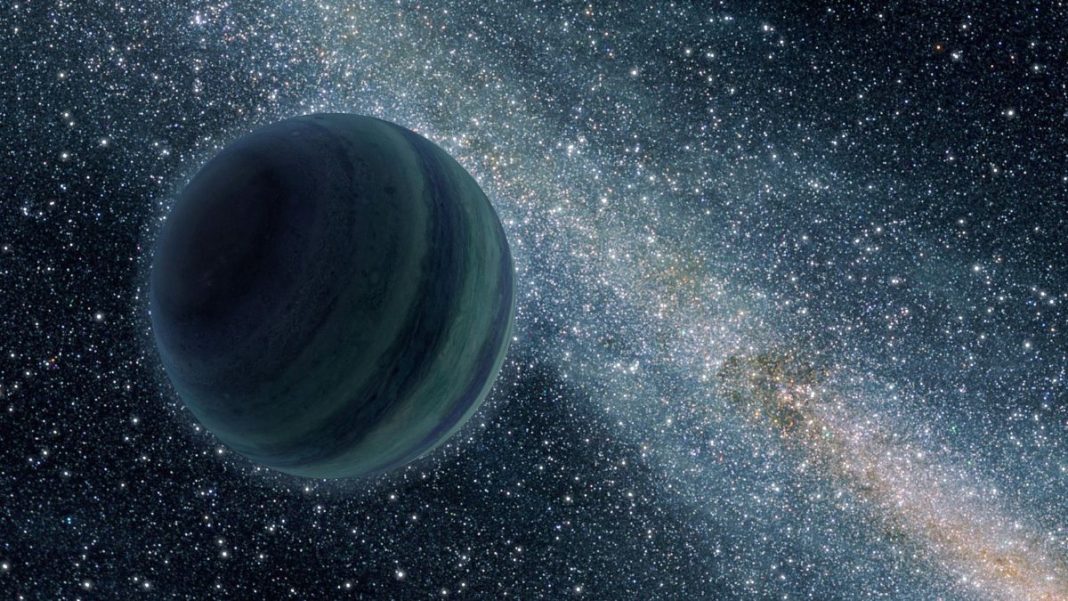

When people think about habitable worlds, they usually start with the same assumption: you need a star.
That is a reasonable assumption, but it may not be the whole story. New research suggests that moons orbiting rogue planets — planets drifting through space without any host star — could still stay warm enough to support liquid waterfor extremely long periods. In the strongest modeled cases, an Earth-sized moon orbiting a Jupiter-like rogue planet could remain habitable for up to 4.3 billion years if it has a dense hydrogen atmosphere.
That is the part that matters most up front. Not the sci-fi image of a frozen world floating in darkness, but the fact that “no sunlight” does not automatically mean “no chance for life.” According to the study, tidal heating from the gravitational pull between a rogue planet and its moon could provide the internal energy, while a hydrogen-rich atmosphere could trap that heat well enough to keep water liquid.
What Is a Rogue Planet?
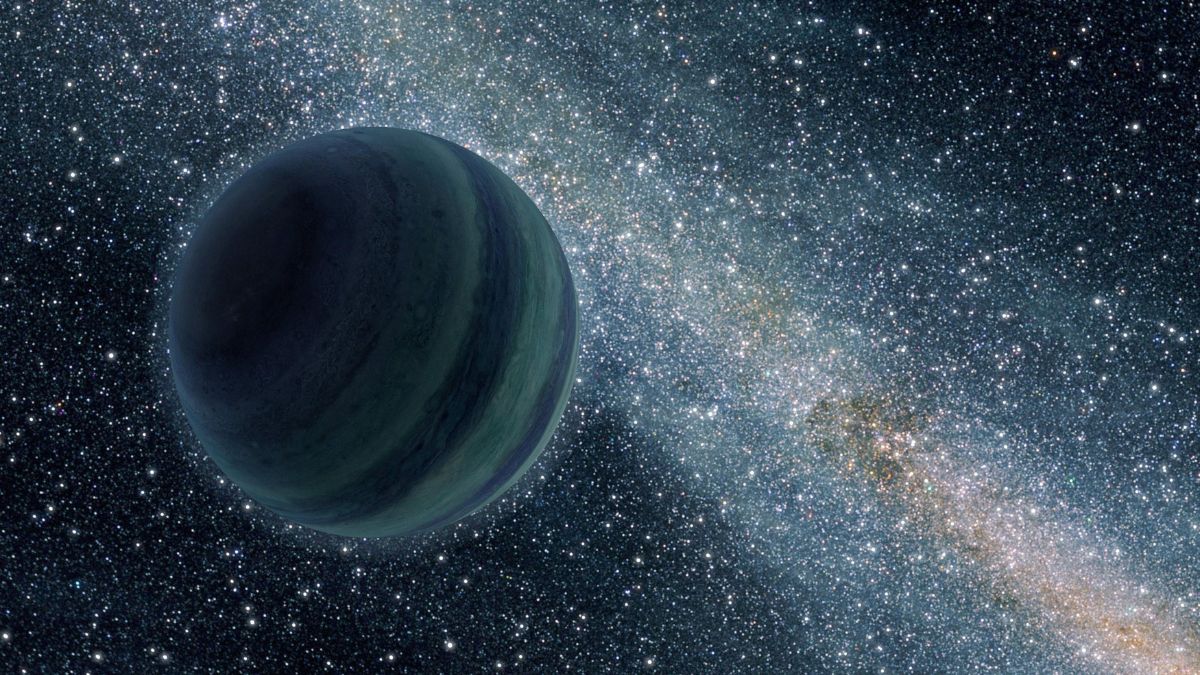
A rogue planet is exactly what it sounds like: a planet that is not orbiting a star.
Instead of circling a sun the way Earth does, these worlds drift through interstellar space. That makes them sound useless for life at first glance, because without starlight, the surface should be brutally cold. But astronomers have been revisiting that assumption for a while, especially when it comes to large rogue planets with moons. Older work already suggested that the right moon-planet setup could hold onto heat for a long time.
How Could a Moon Stay Warm Without a Sun?
This is where the idea stops sounding ridiculous and starts sounding physically plausible.
The heat would not come from sunlight. It would come from tidal heating. That happens when a moon is repeatedly stretched and squeezed by the gravity of the planet it orbits, creating friction inside the moon and generating heat. We already see a version of this in our own solar system. Jupiter’s moon Io is intensely volcanic because of tidal forces, and icy moons like Europa and Enceladus are considered promising places to search for subsurface oceans partly for the same reason. The new study applies that logic to rogue planets and asks what happens if the moon also has a hydrogen atmosphere strong enough to trap the heat.
The answer is: potentially a lot.
The LMU Munich team found that with Earth-like pressure, surface liquid water might last up to about 95 million years. That is not trivial, but it is not ideal either. With a much thicker hydrogen atmosphere, though, the numbers become much more serious. At around 100 bars of surface pressure, their modeled moon could keep liquid water on the surface for as long as 4.3 billion years.
Why Hydrogen Matters So Much
This is the real hinge of the whole idea.
Previous work had already explored whether a moon around a rogue planet could stay habitable with a carbon dioxide atmosphere, but carbon dioxide has a major weakness in these conditions: in extreme cold, it can condense out, which means it stops doing a good job of trapping heat. Hydrogen behaves differently. It stays gaseous at much lower temperatures and can produce a much stronger greenhouse effect in a cold, dark environment. That makes it far better suited to keeping these moons warm.
So the basic logic is not “life can thrive anywhere.” It is narrower than that. It is more like this: if you have the right kind of moon, orbiting the right kind of rogue planet, with enough internal heating and a thick enough hydrogen atmosphere, the conditions for liquid water may last long enough for life to begin.
Could Life Actually Start There?
This is where people need to slow down.
The study does not show that life exists on rogue-planet moons. It does not even show that such moons are common. What it shows is that the physical conditions needed for habitability may be possible for far longer than many scientists assumed. That is a big difference.
Still, the timescales matter. On Earth, life appears to have emerged relatively early in planetary history, so a world that stays wet and stable for hundreds of millions or even billions of years is much more interesting than one that is briefly warm and then freezes over. In that sense, a rogue moon with a thick hydrogen atmosphere moves from “fun idea” into “serious astrobiology target.”
Why This Idea Is More Important Than It Sounds
The obvious reason is that it expands the map of where life might exist.
Most habitability discussions still revolve around the habitable zone around stars — the range where a planet could have liquid water on its surface. This new work does not make that framework useless, but it does weaken the old assumption that a star is always required. As the study’s lead author put it, the “cradle of life” may not necessarily require a sun.
That is a big shift. It means some potentially life-friendly worlds could be floating in complete darkness, invisible to the kinds of searches that focus only on star systems.
The Big Catch
There are several, actually.
First, this is a modeling study, not a detection. It depends on assumptions about moon size, orbital distance, atmosphere thickness, and how stable these systems remain over time. Second, a 100-bar hydrogen atmosphere is extremely thick, and we do not yet know how common such atmospheres would actually be on rogue exomoons. Third, even if these worlds exist, they would be very hard to detect and study because they do not orbit bright stars that make them easier to find.
So no, this is not proof of alien life hiding on starless moons. It is a more disciplined and more interesting claim: the universe may have more long-lived habitable environments than our standard star-centered picture allows.
The Bottom Line
The old assumption was simple: no sun, no heat, no life.
This new research says that may be too narrow. A moon orbiting a rogue planet could, under the right conditions, stay warm through tidal heating alone, while a hydrogen atmosphere traps enough energy to keep water liquid for up to 4.3 billion years. That does not mean life is there. But it does mean we may need to stop thinking of habitable worlds as places that always need daylight.